CJC-1295 Ipamorelin Canada: Blend Identity and COA Notes (Not Stocked)
CJC-1295 ipamorelin, not stocked at Hermetica: identity data for both components, what a blend label should state and what a two-component COA must show. RUO, 21+.
Short answer: Hermetica Research Labs does not stock CJC-1295, ipamorelin or any CJC-1295 ipamorelin blend in Canada. There is no product page, price, lot or certificate of analysis for either compound on this site, and nothing here is an offer to sell them. This page is for laboratories that need to document a CJC-1295/ipamorelin vial obtained elsewhere: which CJC-1295 is meant, what the label should state, and what a two-component certificate must show. It does not discuss use in humans or animals.
Key takeaways
| Question | Short answer | Source |
|---|---|---|
| Is it sold here? | No. Not stocked, no SKU, no COA on this site | Hermetica catalogue |
| What is in the vial? | Two peptides: a CJC-1295 analogue plus ipamorelin | Label convention |
| Ipamorelin identity | 5 residues, C38H49N9O5, 711.9 g/mol, CAS 170851-70-4 | PubChem CID 9831659 |
| CJC-1295 (with DAC) identity | C165H269N47O46, 3647.2 g/mol, CAS 446262-90-4 | PubChem CID 91971820 |
| CJC-1295 no DAC | About 3,368 Da, roughly 280 Da lighter than the DAC form | DAC vs no-DAC table |
| Minimum blend COA | Two identities, two amounts, separated peaks, matching lot | Analytical practice (D'Hondt et al. 2014) |
What "CJC-1295 ipamorelin" means on a label
Searches for "CJC-1295 ipamorelin", "CJC-1295/ipamorelin" and "ipamorelin CJC 1295" all describe the same thing: one vial, or a two-vial kit, holding two different peptides. The names come from two separate research programmes. Ipamorelin was described in 1998 as a pentapeptide growth hormone secretagogue (Raun et al. 1998). CJC-1295 was described in 2005 as a modified GRF(1–29) analogue built to bind albumin (Jetté et al. 2005). They are separate molecules and each needs its own identity record.
| Field | Ipamorelin | CJC-1295 |
|---|---|---|
| Length | 5 residues | 29 residues (no DAC) or 30 (with DAC) |
| Sequence or base | Aib-His-D-2-Nal-D-Phe-Lys-NH2 | GRF(1–29) amide with D-Ala2, Gln8, Ala15, Leu27 |
| Formula / mass | C38H49N9O5, 711.9 g/mol | C165H269N47O46, 3647.2 g/mol (DAC form) |
| CAS | 170851-70-4 | 446262-90-4 |
| Reference | PubChem CID 9831659 | PubChem CID 91971820 |
Because the two components differ in mass by a factor of about five, a certificate that reports intact masses can tell them apart easily. For the with-DAC versus no-DAC question in detail, see the CJC-1295 DAC vs no-DAC identity table. Single-compound ipamorelin notes are at ipamorelin Canada.
What a blend label should state
- Both compound names, with the CJC-1295 form (with or without DAC) written out.
- The mass of each component in mg, not only a combined total. "10mg blend" does not say how much of either compound the vial holds.
- One lot number that ties the vial to its certificate.
- The supplier's storage statement.
What a two-component certificate must show
A single purity percentage for a blend says little. It does not show whether both components are present in the stated ratio, or whether one has degraded. Related-substance and degradation impurities in peptides are a known analytical issue, which is why each component needs its own result (D'Hondt et al. 2014). A useful blend certificate reports:
- Two identities. A mass result for each component: one near 711.9 Da for ipamorelin and one that fits the CJC-1295 form named on the label.
- Two quantities. The measured amount or proportion of each component, so the label ratio can be checked.
- Separated peaks. A chromatogram in which the two components are resolved, with the method and detection wavelength stated.
- Lot match. The same lot number as the vial.
If a supplier can only provide certificates for each compound tested before blending, file both and note that neither describes the finished mixed vial. For the general method, see how to read a peptide COA.
Questions to put to a blend supplier
- Which CJC-1295 form is in the vial, with or without DAC, and what CAS number applies?
- How many milligrams of each component does the vial contain?
- Was the certificate produced on the finished blend, or on each component before mixing?
- Does the certificate give an identity result for both components and resolve them as separate peaks?
- Can the test number be verified on the issuing laboratory's own system, and does the lot match the vial?
A blend that cannot be documented component by component is, for record purposes, an unidentified mixture.
Receiving checklist
- Names and CJC-1295 form match between label, invoice and certificate.
- Per-component masses are stated.
- The certificate reports an identity for each component and can be verified with the issuing laboratory.
- The lot number matches.
- The material is filed as an in-vitro laboratory reagent.
CJC-1295 and ipamorelin in Canada: catalogue status
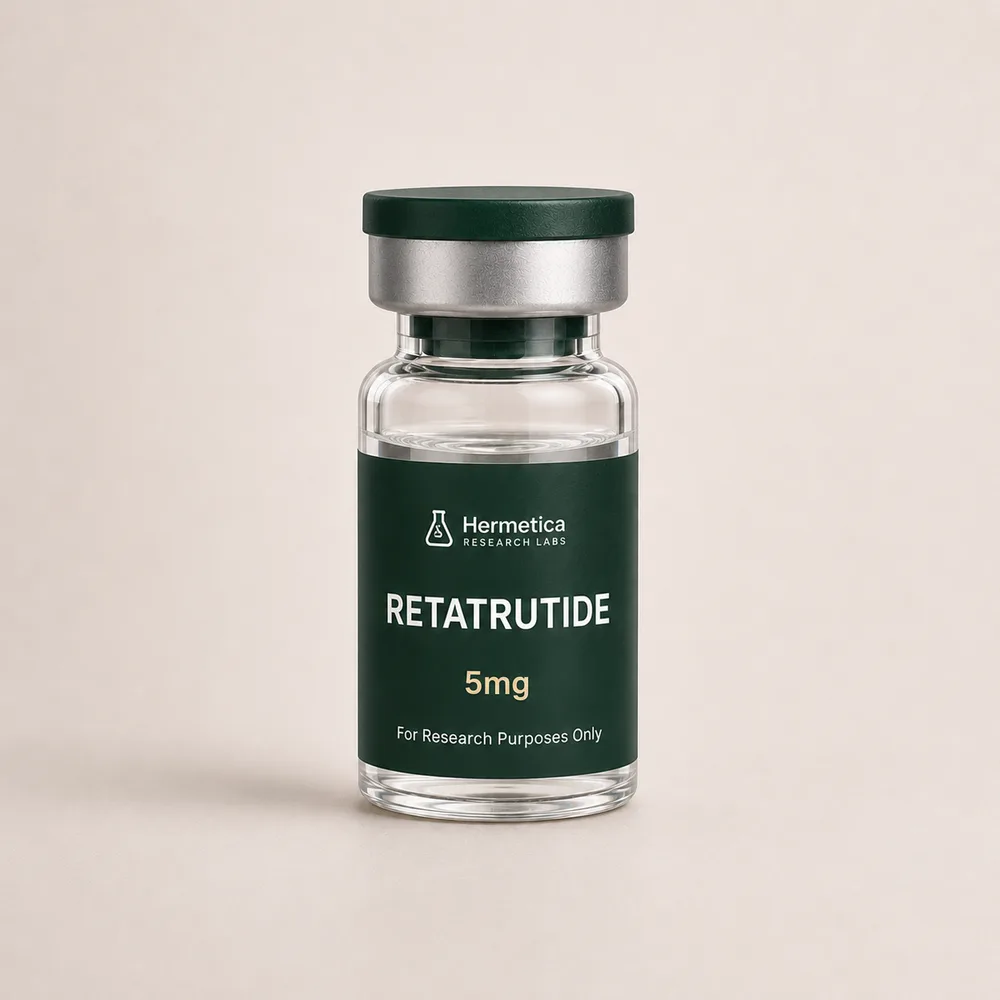
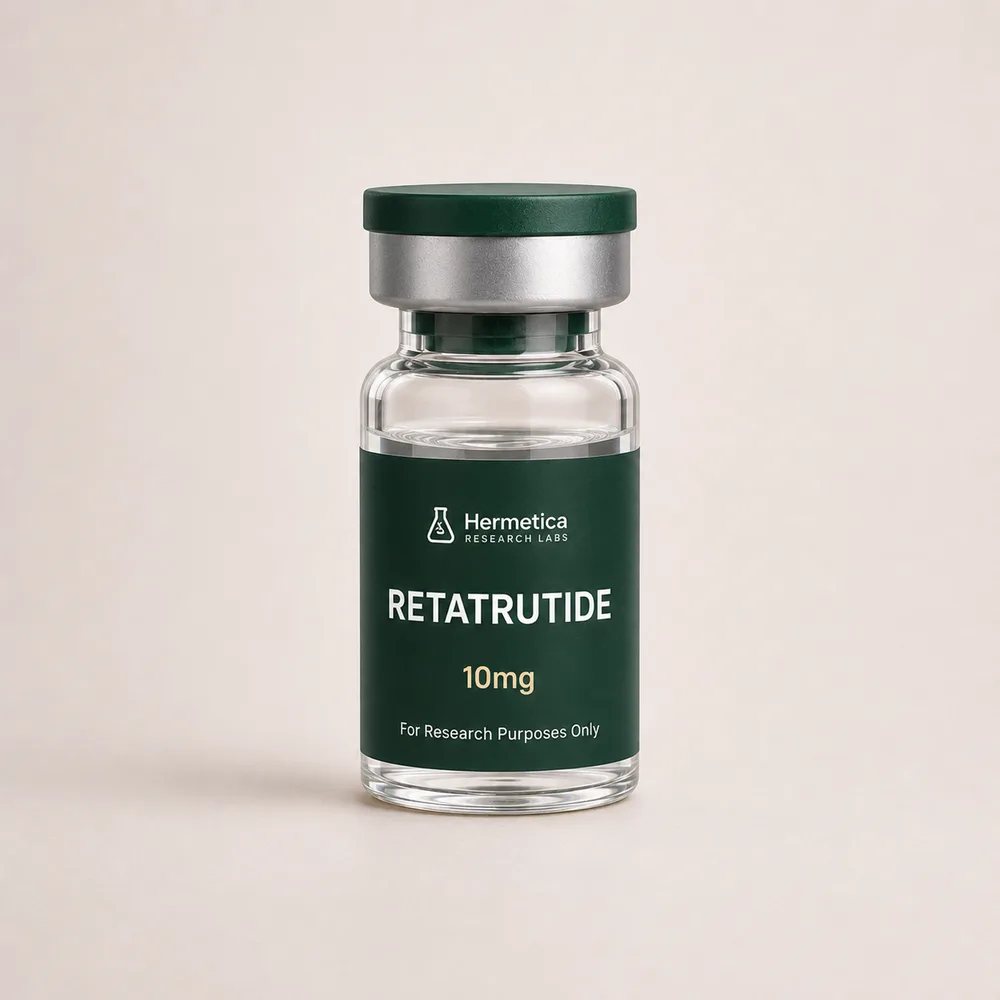
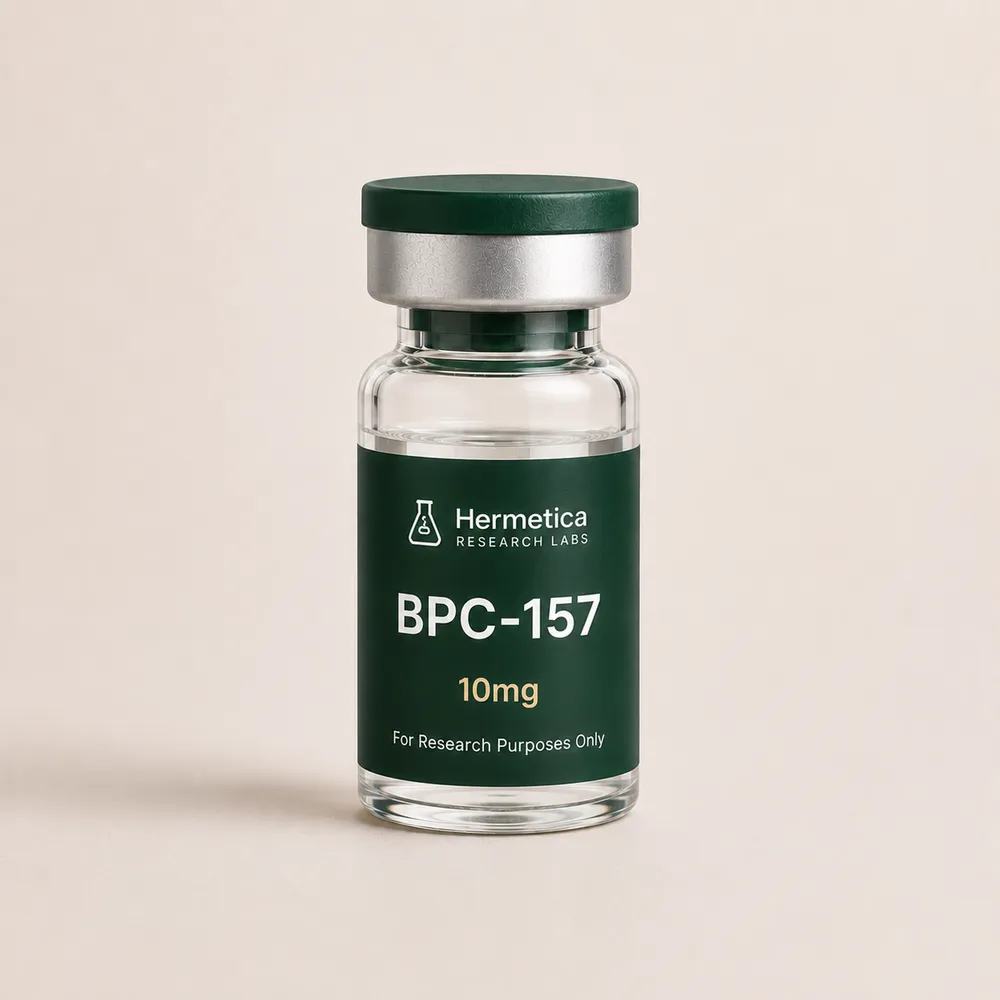
Hermetica does not currently stock CJC-1295 (either form), ipamorelin or a CJC-1295/ipamorelin blend, so there is no price, SKU or certificate for them here. The live catalogue holds single-compound vials only, each with its own documentation. For example, BPC-157 10mg and TB-500 10mg carry separate Janoshik Analytical certificates, and the BPC-157 and TB-500 page shows how two separate vials keep two clean records. Related identity notes: sermorelin Canada and tesamorelin Canada.
Frequently asked questions
Does Hermetica sell CJC-1295 ipamorelin in Canada?
No. Hermetica does not stock CJC-1295 (with or without DAC), ipamorelin or a CJC-1295/ipamorelin blend. There is no product page, price, lot or certificate for them on this site.
What is CJC-1295 ipamorelin?
It is a label for a vial or kit that holds two separate peptides: a CJC-1295 GHRH(1–29) analogue and ipamorelin, a five-residue peptide (C38H49N9O5, 711.9 g/mol, CAS 170851-70-4). They are two molecules, not one compound.
Which CJC-1295 is in a CJC-1295/ipamorelin blend?
Only the label or certificate can tell you. Blends are usually sold with the no-DAC form, but a label that does not say with or without DAC is incomplete. The two forms differ by roughly 280 Da, so an intact-mass result settles it.
What should a CJC-1295 + ipamorelin COA show?
Two identity results, one per component, a separate amount or ratio for each, resolved chromatogram peaks, the method used, and a lot number that matches the vial. A single purity figure for the whole blend is not enough.
Is CJC-1295 the same as ipamorelin?
No. CJC-1295 is a 29- or 30-residue GHRH analogue of about 3,368 to 3,647 Da. Ipamorelin is a 5-residue peptide of 711.9 Da. They are often sold together, which is why the combined search terms exist.
Do you provide preparation or usage information for this blend?
No. This page covers naming, labels and certificates for laboratory records only. It contains no amounts, preparation, administration or outcome information.
Scope
This page contains no information on amounts, preparation, administration, effects or outcomes in people or animals, and it makes no regulatory statement.
Related pages
- CJC-1295 DAC vs no-DAC identity table
- Ipamorelin Canada identity notes
- How to read a peptide COA
- Buy peptides Canada: the live RUO catalogue
References
- PubChem. Ipamorelin, CID 9831659: molecular formula C38H49N9O5, molecular weight 711.9 g/mol; synonym CAS 170851-70-4. pubchem.ncbi.nlm.nih.gov/compound/9831659
- PubChem. CJC-1295, CID 91971820: molecular formula C165H269N47O46, molecular weight 3647.2 g/mol; synonym CAS 446262-90-4. pubchem.ncbi.nlm.nih.gov/compound/91971820
- Raun K, Hansen BS, Johansen NL, Thøgersen H, Madsen K, Ankersen M, Andersen PH. (1998). Ipamorelin, the first selective growth hormone secretagogue. European Journal of Endocrinology, 139(5), 552–561. doi:10.1530/eje.0.1390552
- Jetté L, Léger R, Thibaudeau K, Benquet C, Robitaille M, Pellerin I, et al. (2005). Human growth hormone-releasing factor (hGRF)1–29-albumin bioconjugates activate the GRF receptor on the anterior pituitary in rats: identification of CJC-1295 as a long-lasting GRF analog. Endocrinology, 146(7), 3052–3058. doi:10.1210/en.2004-1286
- D'Hondt M, Bracke N, Taevernier L, Gevaert B, Verbeke F, Wynendaele E, De Spiegeleer B. (2014). Related impurities in peptide medicines. Journal of Pharmaceutical and Biomedical Analysis, 101, 2–30. doi:10.1016/j.jpba.2014.06.012
Research Use Only. Not for human or veterinary use. Purchasers must be 21 or older.
All content is provided for informational purposes for qualified researchers working with research materials in a laboratory setting. Products supplied by Hermetica Research Labs are sold strictly for in-vitro research. They are not intended for human or veterinary use, and nothing on this page constitutes medical, health, or dosing guidance. Must be 21+ to purchase.
Order RUO research materials
Flat $15 shipping across Canada · Free on orders of $150 or more · Canada only · 21+ · Research Use Only, not for human or veterinary use.
Related research peptides
Related research
- Ipamorelin Canada — RUO Pentapeptide Identity Notes (Not Stocked)
Ipamorelin as a five-residue identity record: sequence with non-coded and D-amino acids, CAS, formula, mass, and what a standard certificate can and cannot confirm. Not stocked. RUO, 21+.
- Sermorelin Canada: What Sermorelin Peptide Is, CAS 86168-78-7, and vs Tesamorelin and Ipamorelin (Not Stocked)
Sermorelin identity reference for Canadian labs: GHRH(1-29)-NH2, CAS 86168-78-7, 3357.9 g/mol, the sermorelin peptide label, and sermorelin vs tesamorelin vs ipamorelin. Not stocked. Research Use Only.
- CJC-1295 DAC vs No-DAC — Identity Table for Lab Records (Not Stocked)
CJC-1295 DAC vs no-DAC identity table for Canadian labs: masses, Mod GRF naming and certificate checks. Not stocked. RUO, 21+.