Wolverine Stack (BPC-157 + TB-500) in Canada — Identity, COAs and Blend Labels (RUO)
The wolverine stack is a trade name for BPC-157 and TB-500 sold together. Hermetica sells no blend: two separate Research Use Only vials, each with its own Janoshik certificate.
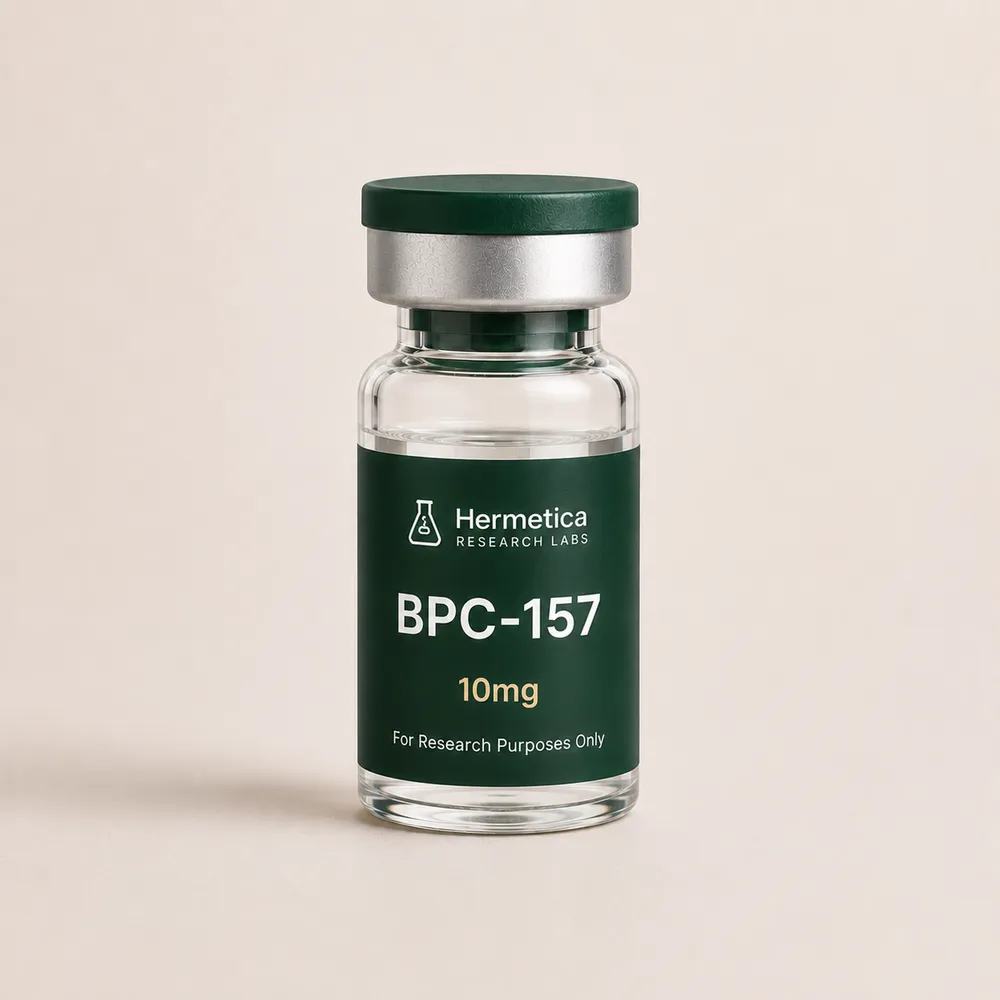
Searches for the "wolverine stack" in Canada usually mean BPC-157 and TB-500 sold together. Hermetica Research Labs does not sell a wolverine stack, blend or combo vial. BPC-157 10mg and TB-500 10mg are two separate Research Use Only catalogue lines, each in its own vial with its own Janoshik Analytical certificate. This page sets the two identities side by side and explains what a combined product would need to document. It covers identity and paperwork only. For the single-compound guides, see Buy BPC-157 Canada and Buy TB-500 Canada.
Key takeaways
| Question | Short answer | Source |
|---|---|---|
| What is the wolverine stack? | A trade name for BPC-157 + TB-500 sold together; not one compound | Supplier usage |
| Does Hermetica sell it? | No: no blend, stack or combo vial | Hermetica catalogue |
| BPC-157 identity | 15 residues, Mr about 1,419 | Pflaum & Ručman 2005 |
| Thymosin beta-4 identity | 43 residues, MW 4982, acetylated N-terminus | Low, Hu & Goldstein 1981 |
| Hermetica lots | BPC-157 Test #97457 (99.576%); TB-500 Test #97450 (99.496%), HPLC-MS | COA library |
| Why one purity figure is not enough for a blend | Related impurities are reported per compound | D'Hondt et al. 2014 |
What is the wolverine stack?
"Wolverine stack" is a name some suppliers use for BPC-157 and TB-500 sold as a pair, either as two vials or as one pre-mixed vial (often labelled 10mg + 10mg or 5mg + 5mg). It is a marketing name, not a chemical one. Each component has its own sequence, mass and CAS number, so a laboratory record has to treat a "stack" as two compounds:
- BPC-157: a synthetic 15-residue peptide. Pflaum and Ručman (2005) report its solid-phase synthesis and a relative molecular mass of about 1419. CAS 137525-51-0.
- TB-500: catalogued by Hermetica as N-terminally acetylated thymosin beta-4, CAS 77591-33-4. Low, Hu and Goldstein (1981) sequenced thymosin beta-4 as a 43-residue peptide with molecular weight 4982 and an acetyl-blocked N-terminus.
Hermetica does not describe or support combined use. The rest of this page is about keeping the two identities and certificates straight.
BPC-157 and TB-500 side by side
| Field | BPC-157 10mg | TB-500 10mg |
|---|---|---|
| SKU | HRL-157 | HRL-500 |
| Compound | Synthetic pentadecapeptide (15 residues) | Thymosin Beta-4 fragment (43 residues, N-terminal acetylated) |
| CAS number | 137525-51-0 | 77591-33-4 |
| Molecular formula | C62H98N16O22 | C212H350N56O78S |
| Molecular weight | ~1419.53 Da | ~4963.44 Da |
| Form | Lyophilized powder | Lyophilized, freeze-dried |
| Listed storage | Cool and dry | Cool and dry |
| Testing laboratory | Janoshik Analytical | Janoshik Analytical |
| Certificate reference | Test #97457 · Batch 1208 | Test #97450 · Batch 1208 |
| Reported purity | 99.576% (HPLC-MS) | 99.496% (HPLC-MS) |
Same laboratory, same batch label, two certificates
Both certificates come from Janoshik Analytical and both list batch 1208, but they are separate tests with separate test numbers: #97457 for BPC-157 and #97450 for TB-500. A shared batch label does not make one report cover the other vial. Record each test number against its own vial and check each one on Janoshik's own verification system. Background on the laboratory is in Janoshik Analytical explained, and the fields to compare are in the Janoshik COA checklist.
Telling the two vials apart on receipt
The two vials share a fill size (10mg) and a listed storage condition, so the label is the only reliable way to tell them apart at receiving:
- Read the compound name exactly as printed on the vial.
- Match the SKU on the packing slip: HRL-157 for BPC-157, HRL-500 for TB-500.
- Match the batch number on the label to the certificate for that compound.
Molecular weight is a useful cross-check when an identity report includes mass data: about 1,419 Da for BPC-157 against about 4,963 Da for TB-500, more than three times heavier.
Not a blend
Both compounds are sold only as individual vials. Hermetica lists no BPC-157 and TB-500 blend, no pre-mixed vial, and no capsule, oral or nasal format of either compound. Nothing on this page describes combined use. Both are Research Use Only laboratory reagents for in-vitro work, not for human or veterinary use, and buyers must be 21 or older.
Ordering both lines in one Canadian order
Each line is added to the cart from its own product page: BPC-157 10mg and TB-500 10mg. Shipping is charged per order, not per vial: a flat $15 CAD, free on orders of $150 CAD or more, with typical transit of 5 to 12 business days in plain packaging to Canadian addresses only. The cart shows the exact total before payment. Full terms are on the shipping policy.
BPC 157 vs TB 500: how the two compounds differ on paper
Searches for "BPC 157 vs TB 500" usually ask which is which. For a laboratory record, the answer is chemical, and the two could hardly be more different:
| Point of comparison | BPC-157 | TB-500 |
|---|---|---|
| What it is | Synthetic 15-residue peptide (pentadecapeptide) | Synthetic peptide catalogued under the thymosin beta-4 name |
| Chain length | 15 residues | 43 residues as catalogued here |
| Approx. mass | ~1,419.5 Da | ~4,963.4 Da |
| CAS | 137525-51-0 | 77591-33-4 |
| Formula | C62H98N16O22 | C212H350N56O78S |
| Sulfur-containing residue | None | Methionine present (watch for +16 Da oxidation) |
| Hermetica lot COA | Janoshik Test #97457 | Janoshik Test #97450 |
Because the masses differ by more than 3,500 Da, any identity report with mass data separates them immediately. Purity percentages alone do not: both lots report above 99% by HPLC-MS.
BPC 157 and TB 500 blends: what the label must show
Some vendors sell a "BPC 157 TB 500 blend" or "combo" in one vial. Hermetica does not, but laboratories that receive one from elsewhere should expect more paperwork, not less:
- Both compound names and the fill mass of each. "10mg blend" is not enough; the label should state, for example, 5mg + 5mg.
- A certificate that reports both components. Two peaks, two identity confirmations, and a figure for each, not one blended purity number.
- One lot number covering the mixed vial. Single-compound certificates for the inputs do not document the mixture.
- The same storage statement for both. If the inputs carry different storage conditions, the blend label should say which applies.
Keeping two single-compound vials, each with its own certificate, avoids all four problems. That is why both are listed separately here.
Wolverine stack, BPC 157 and TB 500: FAQ
What is the wolverine stack?
A supplier trade name for BPC-157 and TB-500 sold together, either as two vials or pre-mixed in one vial. It is not a single compound and has no CAS number of its own.
Does Hermetica sell a wolverine stack?
No. Hermetica sells no wolverine stack, blend or combo vial. BPC-157 10mg and TB-500 10mg are separate Research Use Only vials, each with its own Janoshik certificate.
How do I tell BPC-157 from TB-500 on a certificate?
By mass. BPC-157 is about 1,419 Da (Pflaum and Ručman 2005) and TB-500 is catalogued at about 4,963 Da, so any identity report with mass data separates them.
What should a wolverine stack blend label show?
Both compound names, the fill mass of each (for example 5mg + 5mg), one lot number for the mixed vial, and a certificate that reports each component separately.
Does Hermetica give dosing or protocol guidance for BPC-157 and TB-500?
No. Both are Research Use Only reagents for in-vitro work. Hermetica gives no human-use, dosing, protocol or therapeutic information.
Related pages
- Buy BPC-157 Canada — BPC 157 10mg with lot COA
- Buy TB-500 Canada — SKU and lot COA
- GHK-Cu vs BPC-157 — identity, COA and storage compared
- TB-500 fragment identity and COA notes
- BPC-157 CAS and COA checklist
- Certificates of Analysis
References
- Pflaum Z, Ručman R. (2005). Solid Phase Peptide Synthesis of the Fragment BPC 157 of Human Gastric Juice Protein BPC and its Analogues. Acta Chimica Slovenica, 52, 34–39. PDF
- Low TL, Hu SK, Goldstein AL. (1981). Complete amino acid sequence of bovine thymosin beta 4: a thymic hormone that induces terminal deoxynucleotidyl transferase activity in thymocyte populations. Proceedings of the National Academy of Sciences USA, 78(2), 1162–1166. doi:10.1073/pnas.78.2.1162 · PMC319967
- D'Hondt M, Bracke N, Taevernier L, Gevaert B, Verbeke F, Wynendaele E, De Spiegeleer B. (2014). Related impurities in peptide medicines. Journal of Pharmaceutical and Biomedical Analysis, 101, 2–30. doi:10.1016/j.jpba.2014.06.012 · PubMed 25044089
Research Use Only. Hermetica Research Labs supplies laboratory reagents for in-vitro research. Not for human or veterinary use. Buyers must be 21 or older.
All content is provided for informational purposes for qualified researchers working with research materials in a laboratory setting. Products supplied by Hermetica Research Labs are sold strictly for in-vitro research. They are not intended for human or veterinary use, and nothing on this page constitutes medical, health, or dosing guidance. Must be 21+ to purchase.
Order RUO research materials
Flat $15 shipping across Canada · Free on orders of $150 or more · Canada only · 21+ · Research Use Only, not for human or veterinary use.
Related research peptides
Related research
- CJC-1295 Ipamorelin Canada: Blend Identity and COA Notes (Not Stocked)
CJC-1295 ipamorelin, not stocked at Hermetica: identity data for both components, what a blend label should state and what a two-component COA must show. RUO, 21+.
- GHK-Cu Copper Peptide: What It Is, Identity, COA and Storage (RUO)
Overview of GHK Cu peptide Canada documentation for RUO laboratories: identity fields, COA path, copper peptide GHK-Cu SKUs, and Canada shipping.
- Buy Peptides Canada — Research Peptides Online with Lot COAs
Where to buy research peptides in Canada online: the full Hermetica Research Use Only catalogue, which lines carry a published third-party lot certificate, and Canada-only shipping terms. 21+.