GHK-Cu Formulation Chemistry Research: What the Literature Actually Studies
GHK-Cu is one of the most cited copper peptide complexes in in-vitro cell-culture and formulation-chemistry literature. Here is what the chemistry, the analytical evidence, and the sourcing paperwork actually establish.
GHK-Cu formulation chemistry is one of the more active corners of the peptide literature — the compound turns up repeatedly in in-vitro cell-culture papers and in analytical work on peptide stability in carrier matrices. That volume of literature is often used to imply more than the underlying data supports. This article separates what the chemistry and the analytical record actually show from what marketing copy tends to add on top.
What GHK-Cu Is, Chemically
GHK-Cu is a tripeptide-copper(II) complex: glycyl-L-histidyl-L-lysine coordinated to a copper ion. As a research material it is typically supplied as a lyophilised powder with a characteristic blue-to-blue-green colour, a visual property of the copper coordination itself rather than an indicator of purity on its own.
The molecule's relevance to formulation chemistry comes from its coordination behaviour: the histidine imidazole and the terminal amine groups both participate in binding the copper centre, and that coordination geometry is sensitive to pH, competing ligands, and oxidative conditions — all variables a formulation study has to control for and report.
Why It Appears So Often in Formulation-Chemistry Research
The published literature on GHK-Cu is dominated by two categories of study: in-vitro assays on cultured fibroblast and keratinocyte cell lines, and analytical/formulation-chemistry papers examining how the copper complex behaves once incorporated into a carrier matrix — aqueous stability, compatibility with common excipients, and degradation kinetics under light and heat.
That body of work explains why the compound is a frequent research subject. It does not establish anything about any use outside the laboratory, and citing in-vitro or formulation-stability data as if it describes outcomes in a person is a common but unsupported leap — one worth flagging when reading secondary sources rather than the primary papers.
Formulation-Relevant Chemical Properties
| Property | Research relevance |
|---|---|
| Molecular weight (~340 Da free peptide; complex mass varies with counter-ion) | Needed to convert HPLC peak assignment into a mass check against MS data |
| Aqueous solubility | Governs vehicle selection in stability studies; solubility is pH-dependent |
| Copper coordination stability across pH | Determines whether the complex or free ligand plus dissociated copper is present in a given formulation matrix |
| Oxidative/photostability | Copper complexes are redox-active; degradation pathways are commonly tracked by HPLC over time |
| Lyophilised vs. solution-state stability | Lyophilised powder is markedly more stable in storage than any prepared solution |
Verifying Identity and Purity Before Using Material in a Study
A formulation-stability study is only as good as the starting material's characterisation. That means the same two questions apply here as with any research peptide: does the HPLC purity figure reflect area-percent or mass fraction, and does a mass-spectrum confirm the peak is actually the intended complex rather than the free ligand or a copper-free fragment. The mechanics of reading that data are covered in how to read a peptide certificate of analysis and in what a 99% purity figure on a COA actually means.
For GHK-Cu specifically, the copper coordination adds a wrinkle: a chromatogram and mass spectrum confirm the organic ligand, but they do not by themselves confirm copper occupancy or stoichiometry. A rigorous formulation-research record should document lot-specific data, not a single reference report reused across batches — the same standard covered in third-party tested peptides: what the claim actually means. Hermetica lists issuing-lab reports by batch on its certificates of analysis page.
Storage Considerations for a Copper Peptide Complex
Copper complexes are more susceptible to oxidative degradation than many uncomplexed peptides, which makes storage conditions worth documenting carefully in any formulation-stability protocol — temperature, light exposure, and time from first opening a vial all affect the degradation profile observed on repeat HPLC runs. General handling principles for research peptides, including lyophilised-versus-solution stability and freeze-thaw considerations, are covered in research peptide storage and handling in the laboratory.
Sourcing Material for a Formulation Study
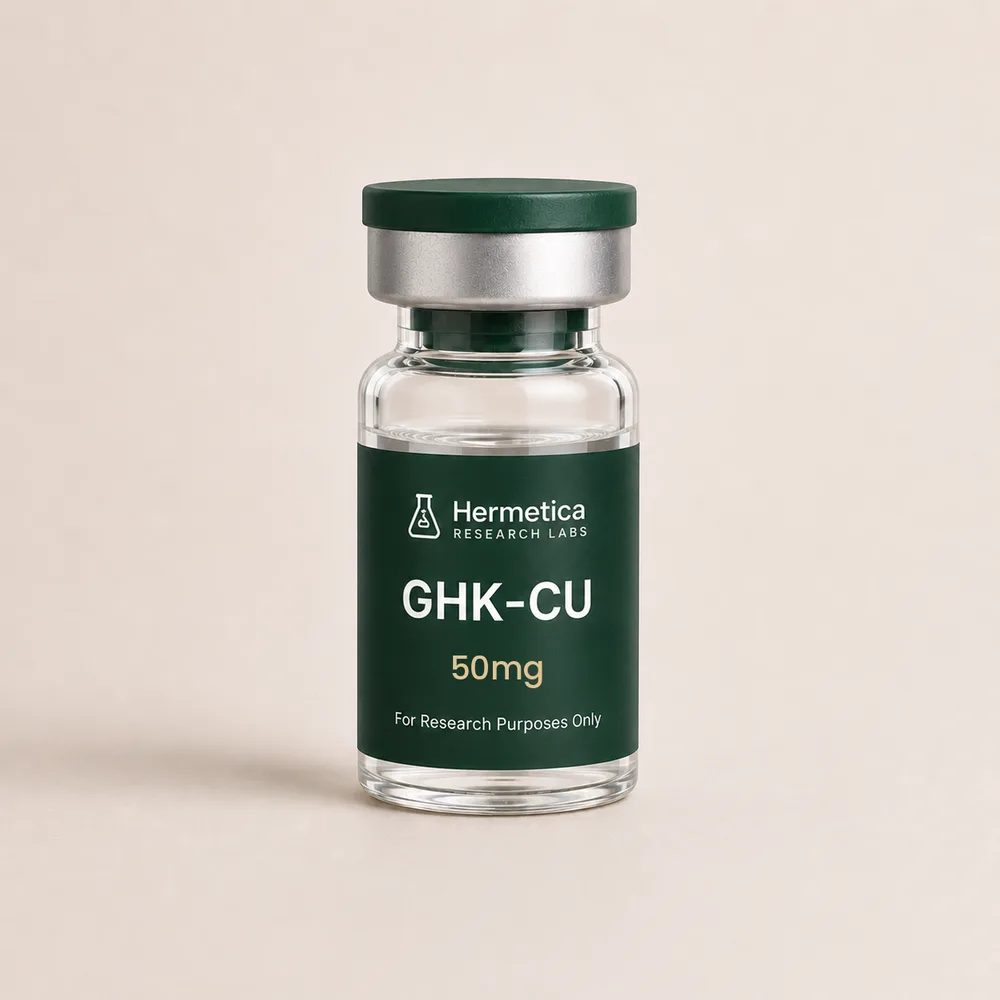
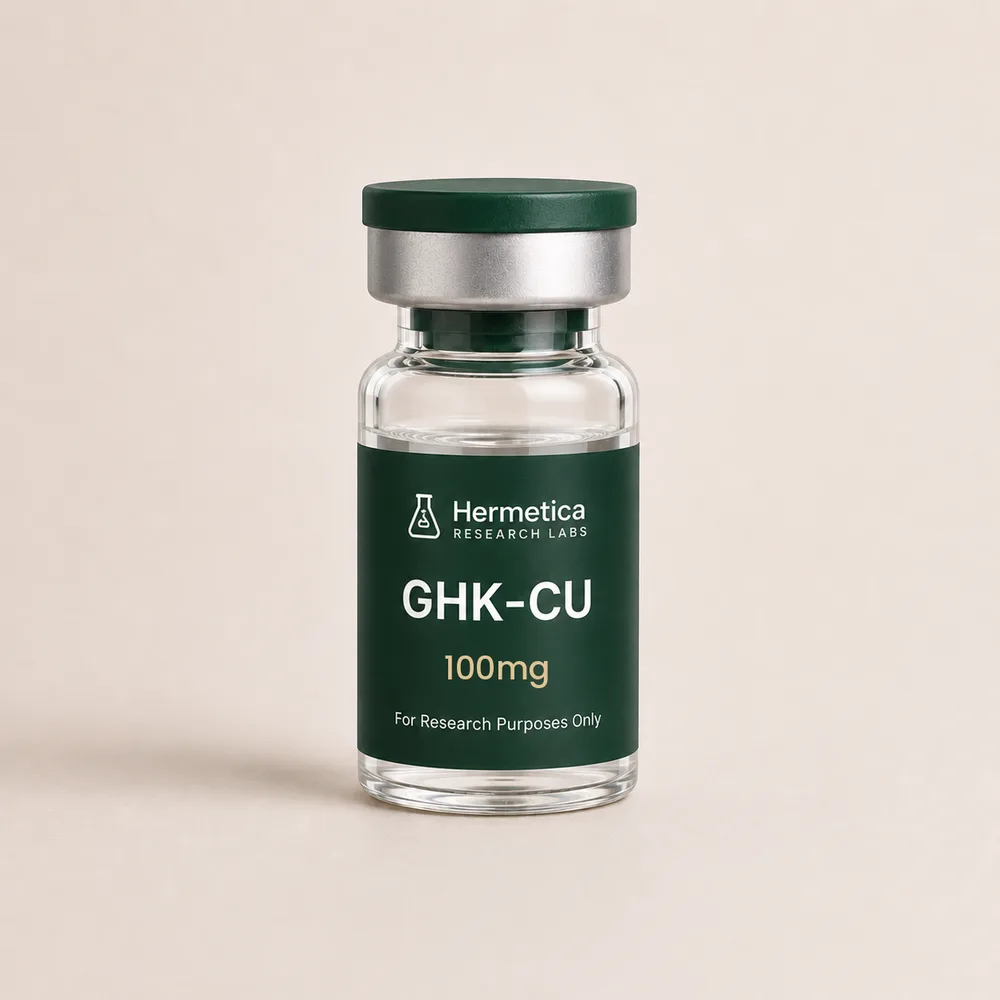
Because GHK-Cu's coordination chemistry is sensitive to trace contaminants and counter-ion identity, formulation researchers have more reason than most to insist on lot-specific analytical documentation rather than a generic product-page purity claim. Material is listed at GHK-Cu 50mg and GHK-Cu 100mg, each tied to batch-specific reporting.
Research Use Only
This article is provided for informational purposes for qualified researchers. GHK-Cu and all Hermetica Research Labs products are sold strictly for laboratory and in-vitro research use only. They are not drugs, cosmetics, or finished consumer goods, are not intended for human or veterinary use, and no claims are made regarding safety or effect in any living organism.
All content is provided for informational purposes for qualified researchers working with research materials in a laboratory setting. Products supplied by Hermetica Research Labs are sold strictly for in-vitro research. They are not intended for human or veterinary use, and nothing on this page constitutes medical, health, or dosing guidance. Must be 21+ to purchase.
Order RUO research materials
Flat $15 shipping across Canada · Free on orders of $150 or more · Canada only · 21+ · Research Use Only, not for human or veterinary use.
Related research peptides
Related research
- How to Read a Peptide Certificate of Analysis
A researcher's guide to reading a peptide COA: HPLC vs mass spectrometry, what a purity percentage actually measures, batch and lot numbers, and the red flags that separate a real third-party report from a decorative one.
- HPLC purity on a peptide COA — Canadian lab notes
What HPLC purity means on a Canadian research peptide Certificate of Analysis versus net peptide content. Research Use Only.
- What is Retatrutide as a research peptide? (identity notes)
Identity-only overview of Retatrutide as a lyophilized RUO research peptide, with COA and Canada links. Not for human or veterinary use.