Research Peptide Storage and Handling in the Laboratory
A technical reference on laboratory storage and handling of research peptides: lyophilised stability, temperature, light and moisture exposure, and why long-term storage is at -20°C or lower.
Research peptides are chemically reactive molecules with a finite shelf-life, and that shelf-life is set almost entirely by how they are stored and handled in the laboratory. This article summarises the practical laboratory factors that determine whether a peptide reagent stays intact from the day it arrives to the day it is used in an assay. The scope here is deliberately limited to storage of the research material itself — this is not preparation or usage guidance.
Lyophilised peptides are stable, but not indefinitely
Most research peptides ship as a lyophilised (freeze-dried) powder. In this form the peptide is essentially free of water, which suppresses the two most common degradation pathways: hydrolysis of the peptide bond and moisture-mediated oxidation of residues such as methionine and cysteine. Lyophilisation is the reason a well-manufactured peptide can be shipped at ambient temperature over short periods without meaningful loss of purity.
Stable is not permanent. Even in the lyophilised state, peptides degrade slowly over time. The rate depends on temperature, on residual moisture in the vial, on the presence of oxidation-prone residues, and on light exposure. The practical laboratory response is to minimise every one of these factors during storage.
Temperature: the primary control
Temperature is the single most important variable.
- Ambient (room temperature, ~20–25 °C): acceptable only for short shipping intervals of a few weeks. Not appropriate for storage.
- Refrigerated (2–8 °C): acceptable for short-term storage of an active working stock over days to a small number of weeks, depending on the peptide.
- Frozen at -20 °C: the standard long-term storage condition for lyophilised research peptides. At this temperature, chemical degradation rates are low enough that a well-sealed vial can be stored for many months to years for most sequences.
- Ultra-low (-80 °C): used where a laboratory has the capacity and the peptide is particularly sensitive or intended for very long archival storage.
The practical rule is that lyophilised peptides are stored at -20 °C for long-term storage unless there is a specific reason to go colder. Repeated freeze-thaw cycles are avoided because each thaw exposes the material to condensation and thermal stress; storing in single-use aliquots is a common laboratory practice for exactly this reason.
Moisture is the enemy of a lyophilised solid
The reason lyophilised peptides are stable is the absence of water. Anything that reintroduces water compromises that stability.
- Vials should be sealed and stored in a way that avoids condensation forming inside the vial when it is moved between temperatures. The common laboratory approach is to remove a sealed vial from the freezer, allow it to warm to room temperature before opening, and only then break the seal.
- Opening a cold vial in a humid room draws atmospheric moisture into the vial as the interior warms and pressure equilibrates. Warming the vial to room temperature before opening — and, where possible, working in a low-humidity environment — reduces this uptake.
- For humidity-sensitive material, storage over a desiccant is standard laboratory practice.
Light and oxygen
Some peptide sequences contain residues that are sensitive to light-driven or oxygen-driven degradation. Tryptophan, methionine, and cysteine are the most commonly cited.
- Light: amber vials and opaque storage boxes are standard laboratory practice for photolabile compounds. When in doubt, store in the dark.
- Oxygen: for the most sensitive sequences, some laboratories flush the vial headspace with an inert gas (nitrogen or argon) before sealing. For most research peptides, keeping the vial sealed and cold is sufficient.
Physical handling
A few laboratory practices reduce the risk of contamination and loss:
- Handle sealed vials by the crimp and cap, not the body; body contact warms the contents and can leave residues on the glass.
- Do not vortex a sealed lyophilised vial vigorously; the powder can lodge in the seal.
- Use clean, dry pipette tips and other laboratory liquid-handling consumables if the vial is opened for any purpose; a peptide vial should be treated with the same discipline as any other reference standard.
- Return the vial to storage promptly; time on the bench is time at ambient temperature.
Documentation and traceability
Storage discipline is only useful if a laboratory can also answer which material was stored where. Every vial should be labelled with the peptide identity, the lot / batch number, and the date it entered inventory. That lot number is what ties the vial back to its Certificate of Analysis and, ultimately, to the analytical evidence that the material is what it claims to be.
If a laboratory suspects a stored reagent has degraded — for example, a vial that was inadvertently left at ambient temperature, or one whose seal integrity is uncertain — the correct response is to re-verify identity and purity analytically before continuing to use the material, not to assume the original COA still applies.
Summary
- Lyophilised is the stable form; keep water out.
- Store long-term at -20 °C, aliquot to avoid freeze-thaw cycles.
- Warm sealed vials to room temperature before opening to prevent condensation.
- Protect light- and oxygen-sensitive sequences accordingly.
- Preserve lot traceability so every vial is tied to its analytical documentation.
For context on evaluating that analytical documentation, see How to read a peptide certificate of analysis. For guidance on sourcing research peptides in Canada in the first place, see Research peptides in Canada: what to know.
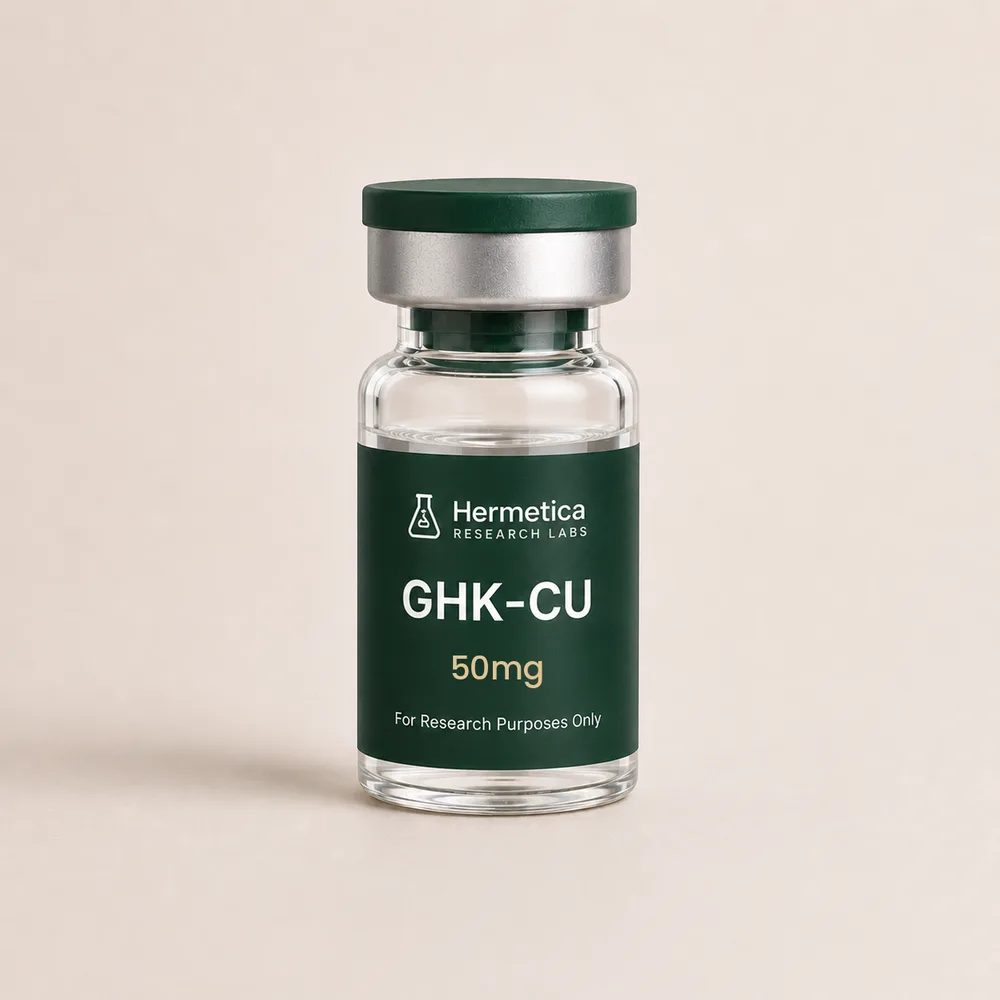
Storage conditions are only meaningful if the material started as labelled. The batch reports behind every lot we ship are published in the COA library, with lot-matched documentation on each product page — for example GHK-Cu and MOTS-c.
All content is provided for informational purposes for qualified researchers working with research materials in a laboratory setting. Products supplied by Hermetica Research Labs are sold strictly for in-vitro research. They are not intended for human or veterinary use, and nothing on this page constitutes medical, health, or dosing guidance. Must be 21+ to purchase.
Order RUO research materials
Flat $15 shipping across Canada · Free on orders of $150 or more · Canada only · 21+ · Research Use Only, not for human or veterinary use.
Related research peptides
Related research
- Peptides Canada | Research Peptides RUO Catalogue
A claim-clean hub for Canadian laboratory sourcing of Research Use Only peptides: catalogue links, Certificates of Analysis, and lot documentation.
- Peptide Certificates of Analysis in Canada — laboratory checklist
How Canadian laboratories review peptide Certificates of Analysis: lot match, HPLC, LC-MS, accession. Research Use Only.
- Freedom Diagnostics peptide COAs for Canadian laboratory documentation
How Canadian labs use Freedom Diagnostics COAs with Hermetica lots — accession, lot match, HPLC/LC-MS. Research Use Only.