GHK-Cu Copper Peptide: What It Is, Identity, COA and Storage (RUO)
Overview of GHK Cu peptide Canada documentation for RUO laboratories: identity fields, COA path, copper peptide GHK-Cu SKUs, and Canada shipping.
Key takeaways
| Question | Short answer | Source |
|---|---|---|
| What is GHK-Cu copper peptide? | The copper(II) complex of Gly-His-Lys | Pickart et al. 1980 |
| Where GHK was found | Human plasma; discovered in 1973 | Pickart & Margolina 2018 |
| Plasma level by age | About 200 ng/mL at age 20, about 80 ng/mL at 60 | Pickart & Margolina 2018 |
| CAS / formula | 89030-95-5 / C14H24N6O4·Cu (as listed) | Hermetica catalogue |
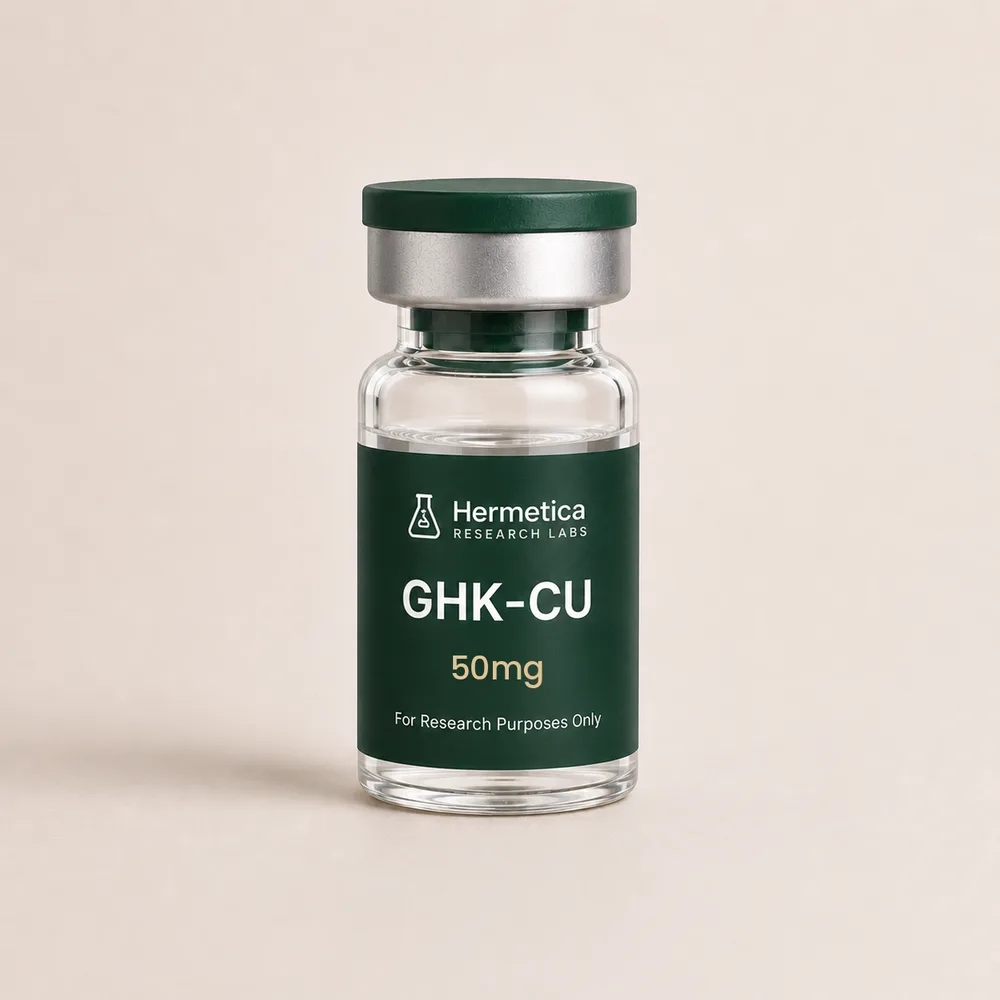
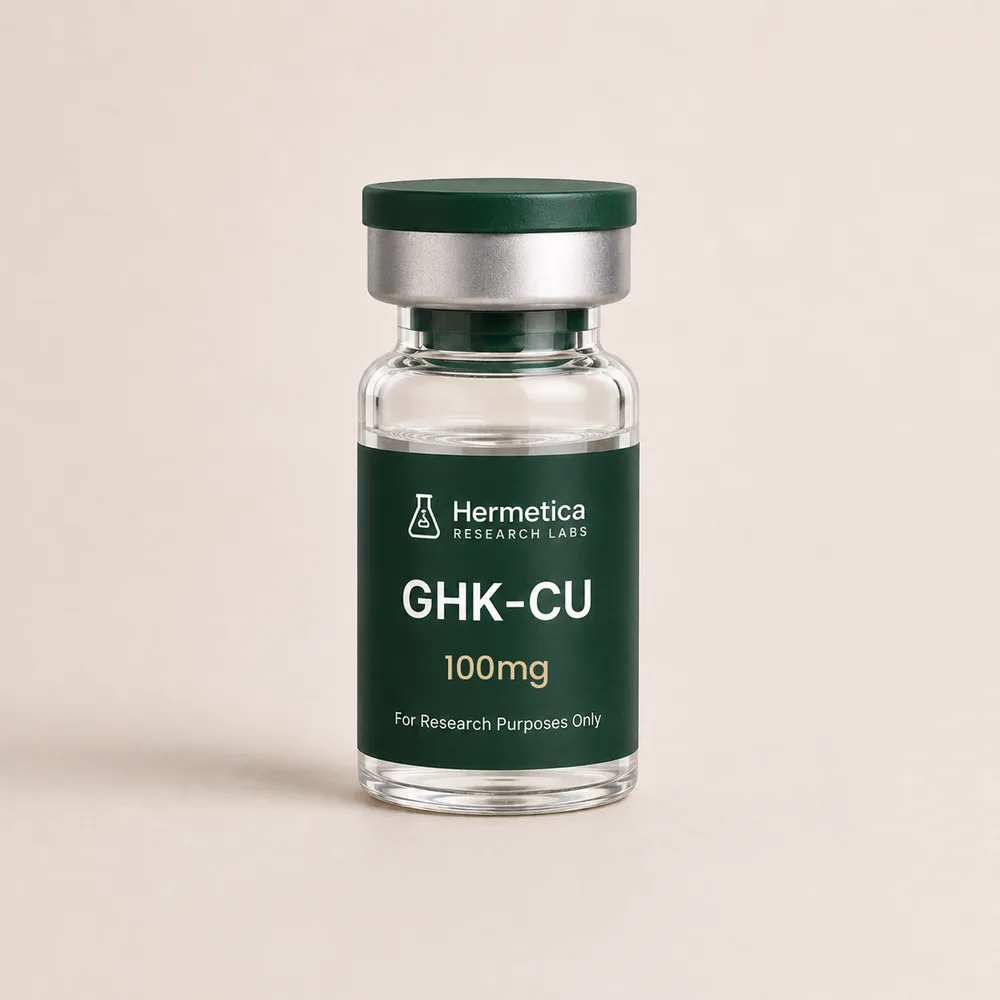
| Sizes | 50mg and 100mg lyophilized | Hermetica catalogue |
| Scope | Research Use Only, in-vitro work, buyers 21+ | Hermetica RUO terms |
GHK Cu peptide Canada is a laboratory documentation topic for research peptides Canada buyers who need clear identity, COA, and Canada sourcing records before adding a reagent to a controlled lab workflow.
Hermetica Research Labs lists copper peptide GHK-Cu as a Research Use Only reagent line for Canadian laboratories. The compound identity is the Gly-His-Lys copper complex, supplied as lyophilized material for documentation-led analytical work only. It is not for human or veterinary use, and buyers must be 21+.
Copper peptide GHK-Cu SKU line
The active catalogue pages for this line are:
Both pages should be checked for the product name, vial size, SKU, CAS field, form, storage statement, purity field, and certificate link where published. Broader catalogue navigation is available through the shop, and the existing Canada buy path is documented at Buy GHK-Cu Canada.
Identity and lot-matched COA path
A Canadian lab should compare the vial label with the certificate record before filing purchase documentation. The fields to check include compound name, nominal fill mass, lot identifier, physical form, purity method, issuing laboratory, and any accession or report reference. Published certificates are listed on the COA index.
Additional GHK-Cu sourcing context is available at Buy GHK-Cu Canada. For certificate reading, use the RUO COA checklist at How to Read a RUO Certificate of Analysis, plus the existing Janoshik peptide COA checklist and Freedom Diagnostics peptide COA verification references.
What is GHK-Cu?
GHK-Cu is the copper(II) complex of the tripeptide glycyl-L-histidyl-L-lysine (Gly-His-Lys). The peptide part, GHK, binds a copper ion through the histidine side chain, the glycine amino group and backbone nitrogens, giving a blue lyophilized material. It is often called a copper peptide, and GHK-Cu is the form most commonly listed by research suppliers. For identity work, the catalogue fields that matter are listed below.
| GHK Cu peptide field | Catalogue value |
|---|---|
| Sequence | Gly-His-Lys, copper complex |
| CAS | 89030-95-5 |
| Formula (as listed) | C14H24N6O4·Cu |
| Form | Lyophilized peptide complex |
| Listed storage | 2–8°C |
| Sizes in catalogue | 50mg and 100mg |
Because the copper is part of the compound, a GHK-Cu certificate should make clear whether its mass and purity figures refer to the free peptide or the copper complex. Record which one the report describes.
GHK Cu peptide in Canada: buyer checks
A Canadian laboratory buying GHK-Cu should check four things: the CAS and sequence on the product page match the vial label; the lot on the certificate is the lot on the vial; the purity method (HPLC, with or without MS) is stated; and the issuing laboratory's report number can be checked on that laboratory's own system. The GHK-Cu COA notes walk through the published certificate, and GHK-Cu vs BPC-157 compares the two identity records side by side.
Canada shipping documentation
Hermetica ships within Canada only. Current catalogue shipping is $15.00 CAD per order, with free shipping on orders of $150.00 CAD or more. These are logistics terms for RUO laboratory procurement records and do not change the Research Use Only status of the material.
Related GHK-Cu Canada notes
For a practical sourcing path, start with Buy GHK-Cu Canada, then compare the two catalogue entries at 50mg and 100mg. Use Buy GHK-Cu Canada for Canada procurement notes and the COA index for published certificates.
Research Use Only. Laboratory documentation for 21+ Canadian labs. Not for human or veterinary use.
GHK-Cu copper peptide: how the copper binds
Pickart et al. (1980) found that during isolation the plasma tripeptide co-purified with roughly equimolar copper, and reported that it readily forms complexes with copper(II). They noted a similarity between the tripeptide and copper-transport sites on albumin, where copper is bound by a histidine next to a basic residue. That is why the catalogue lists GHK-Cu as a copper complex rather than a free peptide, and why the 1:1 copper content is part of its identity.
Pickart and Margolina (2018) date the discovery of GHK to 1973 and report plasma GHK of about 200 ng/mL (around 10⁻⁷ M) at age 20, declining to about 80 ng/mL by age 60. Those are measurements of the naturally occurring peptide, not of any supplied reagent.
Copper peptide vs other GHK-Cu pages
This page covers what GHK-Cu is. For ordering and lot records use Buy GHK-Cu Canada and GHK-Cu Canada lab sourcing; for formulation-chemistry literature see GHK-Cu cosmetic formulation research.
FAQ
What is GHK-Cu copper peptide?
The copper(II) complex of the tripeptide glycyl-L-histidyl-L-lysine (Gly-His-Lys). Pickart et al. (1980) reported that the plasma tripeptide readily forms complexes with copper(II).
Where does GHK come from?
GHK was first isolated from human plasma, with its discovery dated to 1973. Pickart and Margolina (2018) report plasma GHK of about 200 ng/mL at age 20, falling to about 80 ng/mL by age 60.
What is the CAS number for GHK-Cu?
CAS 89030-95-5, with the formula listed as C14H24N6O4·Cu, as shown on the Hermetica product pages.
Is GHK-Cu the same as GHK?
No. GHK is the free tripeptide; GHK-Cu is its copper complex. A certificate should state whether its mass and purity refer to the free peptide or the complex.
Does Hermetica give usage guidance for GHK-Cu?
No. GHK-Cu is supplied only as a Research Use Only reagent for in-vitro laboratory work, with no human-use, cosmetic, dosing or therapeutic guidance.
References
- Pickart L, Freedman JH, Loker WJ, Peisach J, Perkins CM, Stenkamp RE, Weinstein B. (1980). Growth-modulating plasma tripeptide may function by facilitating copper uptake into cells. Nature, 288, 715–717. doi:10.1038/288715a0 · PubMed 7453802
- Pickart L, Margolina A. (2018). Regenerative and Protective Actions of the GHK-Cu Peptide in the Light of the New Gene Data. International Journal of Molecular Sciences, 19(7), 1987. doi:10.3390/ijms19071987 · PMC6073405
Research Use Only. Hermetica Research Labs supplies laboratory reagents for in-vitro research. Not for human or veterinary use. Buyers must be 21 or older.
All content is provided for informational purposes for qualified researchers working with research materials in a laboratory setting. Products supplied by Hermetica Research Labs are sold strictly for in-vitro research. They are not intended for human or veterinary use, and nothing on this page constitutes medical, health, or dosing guidance. Must be 21+ to purchase.
GHK-Cu catalogue links (RUO)
Catalogue and documentation paths for Canadian laboratory records. Research Use Only · 21+ · not for human or veterinary use.
Order RUO research materials
Flat $15 shipping across Canada · Free on orders of $150 or more · Canada only · 21+ · Research Use Only, not for human or veterinary use.
Related research peptides
Related research
- How to read a RUO Certificate of Analysis — peptide purity checklist
RUO COA checklist for Canadian laboratories: identity fields, lot matching, HPLC purity, fill-mass separation, and verification references.
- Buy DSIP Peptide in Canada — DSIP 5mg Nonapeptide (RUO)
DSIP 5mg for Canadian laboratories: the nonapeptide's sequence and identity fields, what the missing lot certificate means, light-protected storage and shipping. RUO, 21+.
- Buy GHK-Cu Peptide in Canada — 50mg & 100mg Vials with Lot COA
Where to buy GHK-Cu in Canada for laboratory research: 50mg and 100mg lyophilized copper tripeptide vials, one Freedom Diagnostics lot certificate, and Canada-only shipping. Research Use Only, 21+.