Tirzepatide Canada: What Tirzepatide Is, Brand Names and Tirzepatide vs Retatrutide (Not Stocked, RUO)
Tirzepatide identity reference for Canadian labs: LY3298176, CAS 2023788-19-2, dual GIP/GLP-1 agonist, brand names and tirzepatide vs retatrutide. Not stocked. Research Use Only.
Tirzepatide Canada searches (about 6,600 a month, plus 27,100 for "tirzepatide" alone, Semrush CA database, October 2026) mostly lead to pharmacy and brand pages. This page is different: Hermetica Research Labs does not stock tirzepatide. There is no tirzepatide product page, price, lot or certificate of analysis on this site, and nothing here is an offer to sell it. What follows is an identity reference for laboratories that keep records on tirzepatide research material obtained elsewhere, or that need to keep it apart from retatrutide, which Hermetica does list. It does not discuss any use in humans or animals.
Key takeaways
| Question | Short answer | Source |
|---|---|---|
| What is tirzepatide? | Synthetic 39-residue peptide, code LY3298176, dual GIP / GLP-1 receptor agonist | Coskun et al. 2018 |
| CAS number | 2023788-19-2 | PubChem CID 166567236 |
| Formula and mass | C225H348N48O68, ~4,813 g/mol | PubChem CID 166567236 |
| Brand names | Mounjaro and Zepbound (trade names listed by PubChem) | PubChem CID 166567236 |
| Closest Hermetica compound | Retatrutide, CAS 2381089-83-2, a different triple-agonist peptide | Coskun et al. 2022 |
| Hermetica status | Not stocked: no SKU, price, lot or certificate | Hermetica catalogue |
What is tirzepatide?
Tirzepatide is a synthetic 39-amino-acid peptide first reported under the code LY3298176. Coskun et al. (2018) describe it as a single peptide with agonist activity at both the GIP and GLP-1 receptors, built on a GIP-based sequence with two Aib residues and a C20 fatty diacid attached to lysine 20. On paper it is identified by CAS 2023788-19-2, formula C225H348N48O68 and an average mass near 4,813 Da (PubChem CID 166567236).
Tirzepatide brand names and the "tirzepatide peptide" label
"Tirzepatide brand name" is a common search. PubChem lists Mounjaro and Zepbound as trade names for the same molecule. A vial sold by a peptide supplier as "tirzepatide peptide" is not either branded product: it is a reagent whose identity rests entirely on its label, its CAS number and a lot-matched certificate. Record it under the compound name and CAS, not a brand name.
Tirzepatide vs retatrutide
"Tirzepatide vs retatrutide" and "retatrutide vs tirzepatide" draw a few hundred Canadian searches a month each. On paper:
| Field | Tirzepatide | Retatrutide |
|---|---|---|
| Code name | LY3298176 | LY3437943 |
| CAS | 2023788-19-2 | 2381089-83-2 |
| Length | 39 residues | 39 residues |
| Receptor targets described | GIP, GLP-1 (Coskun 2018) | Glucagon, GIP, GLP-1 (Coskun 2022) |
| Approx. mass | ~4,813 Da | ~4,731 Da |
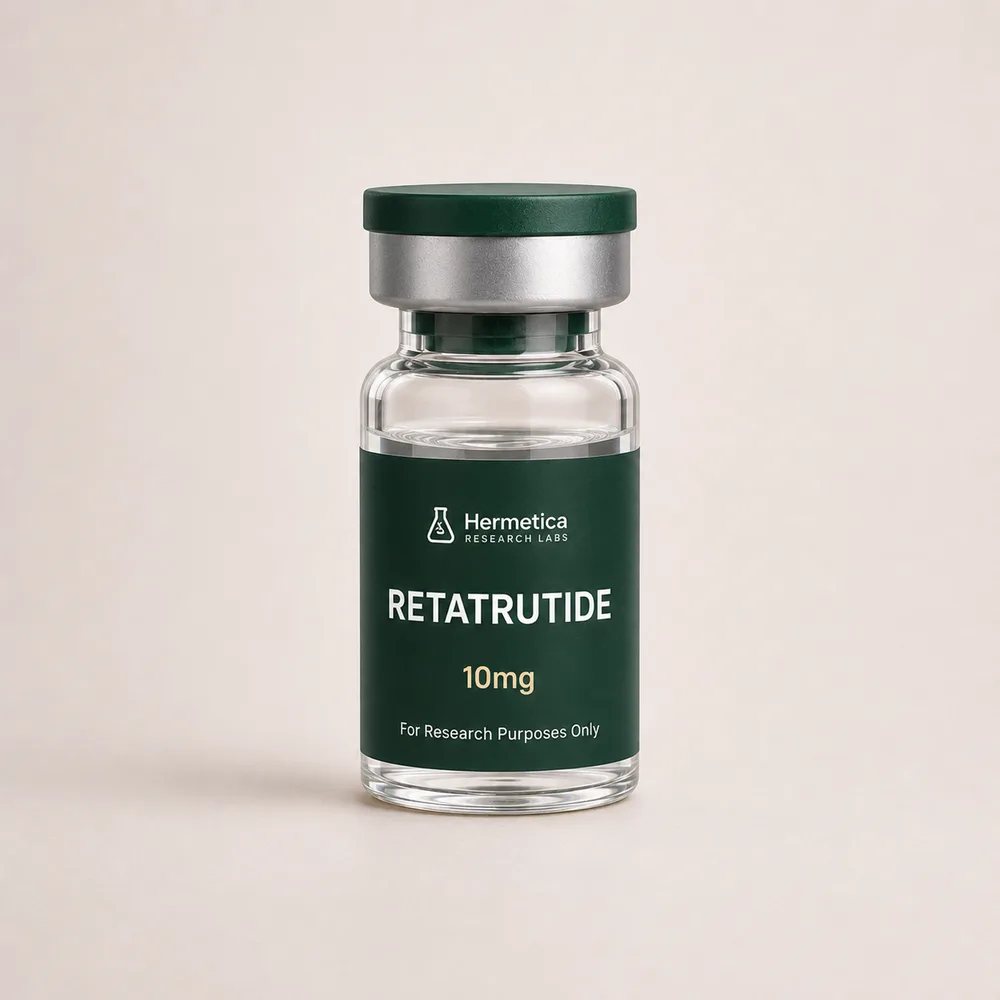
| Hermetica status | Not stocked | Listed as Retatrutide 10mg, Research Use Only |
Both are lipidated 39-residue peptides from the same developer, so a single mass figure is the quickest way to tell them apart: the two differ by roughly 80 Da. A label naming one and a certificate reporting the mass of the other is a mismatch, whatever the purity figure. For retatrutide itself, see what is retatrutide.
Tirzepatide identity at a glance
| Field | Reference value |
|---|---|
| Compound type | Synthetic linear peptide, 39 residues, C-terminal amide |
| CAS number | 2023788-19-2 |
| Molecular formula | C225H348N48O68 |
| Average molecular weight | ~4813.5 Da |
| Non-coded residues | Two α-aminoisobutyric acid (Aib) residues, positions 2 and 13 |
| Side-chain modification | C20 fatty diacid attached to lysine 20 through a γ-Glu / 2× AEEA linker |
| Hermetica catalogue status | Not stocked — no SKU, lot or certificate |
The 39-residue sequence
Written in three-letter code from the N-terminus:
Tyr-Aib-Glu-Gly-Thr-Phe-Thr-Ser-Asp-Tyr-Ser-Ile-Aib-Leu-Asp-Lys-Ile-Ala-Gln-Lys-Ala-Phe-Val-Gln-Trp-Leu-Ile-Ala-Gly-Gly-Pro-Ser-Ser-Gly-Ala-Pro-Pro-Pro-Ser-NH2
Three features make the record distinctive. Aib at positions 2 and 13 is not one of the twenty coded amino acids, so a supplier's sequence printout that shows Ala or Gly there describes a different molecule. Lysine 20 carries the lipid side chain, so the formula and mass of the bare peptide backbone will not match the reference values above. And the C-terminus is an amide, not a free acid.
Why the certificate looks different for a lipidated peptide
A certificate for a peptide of almost 5 kDa with a fatty diacid attached reads differently from one for a short, unmodified peptide such as GHK-Cu or Epitalon:
- Mass identity. Electrospray mass spectrometry usually reports several multiply charged ions rather than one peak. The report should state how those ions were deconvoluted and whether the result agrees with an average mass near 4813.5 Da.
- Purity by HPLC. The lipid tail makes the molecule strongly retained on reversed-phase columns. A purity figure is only meaningful alongside the method, the detection wavelength and the chromatogram.
- Related substances. Truncated sequences, or peptide missing the side chain, would show different masses. A report that lists them is more informative than one that gives a single number.
- Content vs purity. HPLC purity does not state how much peptide is in the vial. Net peptide content, where reported, is a separate figure.
For a general walkthrough of these fields, see how to read a peptide COA and HPLC vs mass spectrometry testing.
Do not confuse tirzepatide with retatrutide on a label
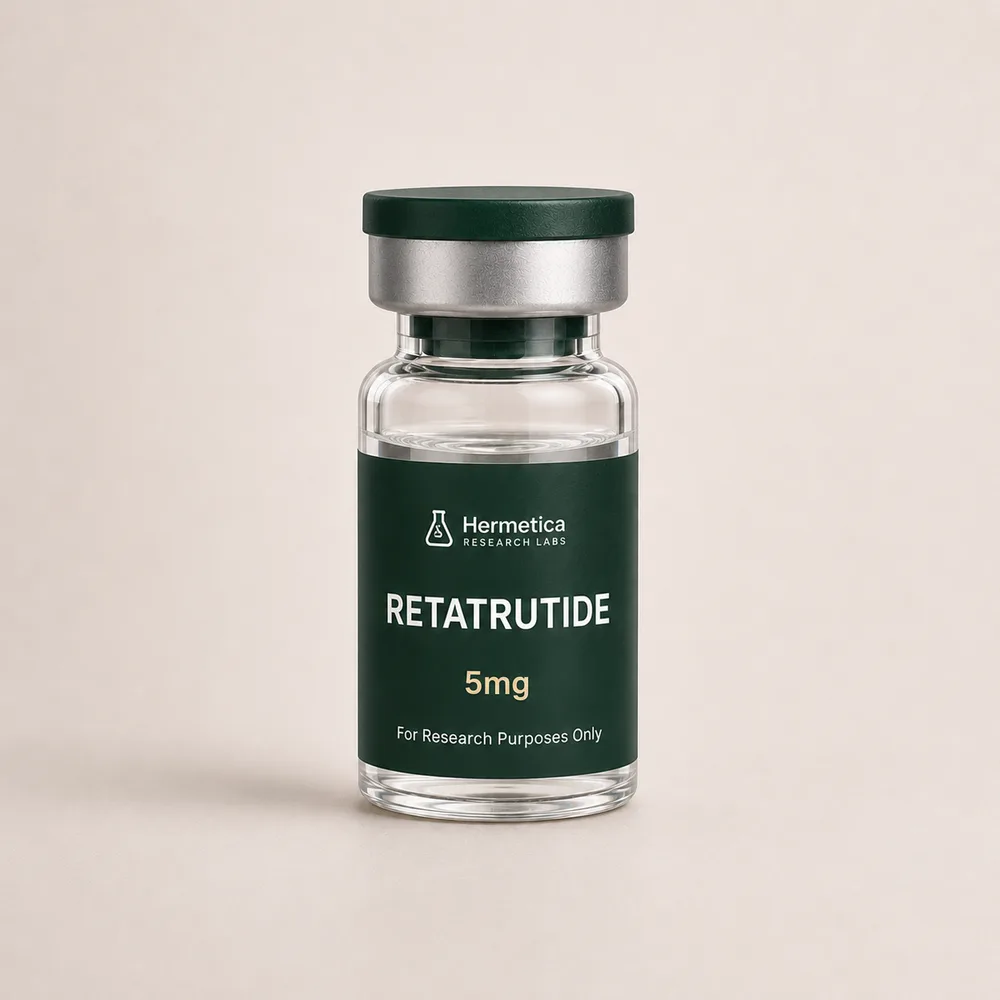
Hermetica lists Retatrutide, a different lipidated research peptide, under CAS 2381089-83-2 with a Freedom Diagnostics certificate. The two compounds have different sequences, CAS numbers and masses, and one certificate never documents the other. When a receiving log holds both names, check:
- the compound name exactly as printed on the vial;
- the CAS number on the label against the CAS on the certificate;
- the reported mass against the reference value for that compound, not the other one;
- the lot number on the vial against the lot on the certificate.
Retatrutide documentation is on the Retatrutide 10mg product page and in the Retatrutide COA checklist.
Receiving checklist for tirzepatide material from any supplier
- The label names tirzepatide and states a fill mass in mg.
- The CAS printed on the label or paperwork is 2023788-19-2, or the supplier explains why it differs (a salt form, for example).
- A lot number is printed on the vial and repeated on the certificate.
- The certificate is issued by an independent laboratory and carries a test or accession number you can check on that laboratory's own system.
- The mass result is consistent with the lipidated molecule, not the bare backbone.
- The material is filed as a laboratory reagent, not a drug, supplement or cosmetic.
Fill mass, salt form and peptide content
The milligram figure on a vial label is the mass of powder the supplier intended to fill. For a large lipidated peptide, that powder normally includes counter-ions (often acetate or trifluoroacetate) and some residual water, so the amount of peptide itself is lower than the label figure. A certificate that reports net peptide content answers that question; one that reports only HPLC purity does not. Record which of the two figures you have. If a supplier gives a salt form, note it beside the CAS number, because a salt form can be listed under a different registry entry from the free peptide. None of this changes the identity of the molecule, but it does change how two lots or two suppliers can be compared on paper.
What this page does not cover
This page gives no information on administration, amounts, effects or outcomes in people or animals, and it makes no regulatory statement. It is a structural and documentation reference only.
Related pages
- Buy Retatrutide Canada — RUO vial with lot COA
- What is Retatrutide? Research peptide identity notes
- Third-party tested peptides in Canada — what it means
- Buy peptides Canada — the full RUO catalogue
- Certificates of Analysis
Tirzepatide Canada: FAQ
What is tirzepatide?
A synthetic 39-residue peptide, code name LY3298176, CAS 2023788-19-2. Coskun et al. (2018) describe it as a dual GIP and GLP-1 receptor agonist carrying a C20 fatty diacid side chain.
Does Hermetica sell tirzepatide in Canada?
No. Hermetica does not stock tirzepatide. There is no tirzepatide SKU, price, lot or certificate on this site, and this page is an identity reference only.
What are tirzepatide's brand names?
PubChem lists Mounjaro and Zepbound as trade names for tirzepatide. Research material sold by peptide suppliers is not either branded product.
What is the difference between tirzepatide and retatrutide?
They are different molecules. Tirzepatide (CAS 2023788-19-2, ~4,813 Da) targets the GIP and GLP-1 receptors; retatrutide (CAS 2381089-83-2) adds the glucagon receptor, per Coskun 2018 and 2022.
What is the molecular weight of tirzepatide?
About 4,813 g/mol for formula C225H348N48O68, per PubChem CID 166567236. A salt form such as acetate or TFA adds to the powder mass, not to the peptide.
Does Hermetica give dosing or usage information for tirzepatide?
No. Hermetica gives no human-use, dosing, weight-loss or therapeutic information for any compound, and tirzepatide is not stocked.
References
- PubChem. Tirzepatide, CID 166567236: molecular formula C225H348N48O68, molecular weight ~4813 g/mol; synonyms include CAS 2023788-19-2, Mounjaro (TN) and Zepbound (TN). pubchem.ncbi.nlm.nih.gov/compound/166567236
- Coskun T, Sloop KW, Loghin C, Alsina-Fernandez J, Urva S, Bokvist KB, et al. (2018). LY3298176, a novel dual GIP and GLP-1 receptor agonist for the treatment of type 2 diabetes mellitus: From discovery to clinical proof of concept. Molecular Metabolism, 18, 3–14. doi:10.1016/j.molmet.2018.09.009
- Coskun T, Urva S, Roell WC, Qu H, Loghin C, Moyers JS, et al. (2022). LY3437943, a novel triple glucagon, GIP, and GLP-1 receptor agonist for glycemic control and weight loss: From discovery to clinical proof of concept. Cell Metabolism, 34, 1234–1247.e9. doi:10.1016/j.cmet.2022.07.013
- D'Hondt M, Bracke N, Taevernier L, Gevaert B, Verbeke F, Wynendaele E, De Spiegeleer B. (2014). Related impurities in peptide medicines. Journal of Pharmaceutical and Biomedical Analysis, 101, 2–30. doi:10.1016/j.jpba.2014.06.012
Research Use Only. Not for human or veterinary use. Purchasers must be 21 or older.
All content is provided for informational purposes for qualified researchers working with research materials in a laboratory setting. Products supplied by Hermetica Research Labs are sold strictly for in-vitro research. They are not intended for human or veterinary use, and nothing on this page constitutes medical, health, or dosing guidance. Must be 21+ to purchase.
Order RUO research materials
Flat $15 shipping across Canada · Free on orders of $150 or more · Canada only · 21+ · Research Use Only, not for human or veterinary use.
Related research peptides
Related research
- AOD-9604 Canada — 16-Residue RUO Identity Notes (Not Stocked)
AOD-9604 as a laboratory identity record: sequence, the internal disulfide bond, CAS, formula, mass and the label confusion around growth hormone fragment names. Not stocked. RUO, 21+.
- Ipamorelin Canada — RUO Pentapeptide Identity Notes (Not Stocked)
Ipamorelin as a five-residue identity record: sequence with non-coded and D-amino acids, CAS, formula, mass, and what a standard certificate can and cannot confirm. Not stocked. RUO, 21+.
- Sermorelin Canada: What Sermorelin Peptide Is, CAS 86168-78-7, and vs Tesamorelin and Ipamorelin (Not Stocked)
Sermorelin identity reference for Canadian labs: GHRH(1-29)-NH2, CAS 86168-78-7, 3357.9 g/mol, the sermorelin peptide label, and sermorelin vs tesamorelin vs ipamorelin. Not stocked. Research Use Only.